





Quick Read
- A SaaS pitch deck fails not because the product is weak, but because the story is unclear - investors fund narratives, not features.
- The best pitch deck design for SaaS companies combines slide structure, investor-ready metrics (MRR, ARR, NRR), and visual clarity that signals execution ability.
- Most investors decide within the first three slides whether they will keep reading - your problem and solution framing carries more weight than any financial model.
- A great pitch deck is not a company overview - it is a fundraising instrument built to answer one question: "Why now, why this team, why this market?"
Table of Contents
-
- Introduction
- What is a SaaS pitch deck (and why do most of them fail)?
- What do investors actually look for in a SaaS pitch deck?
- How many slides should a SaaS pitch deck have?
- The 10 essential slides every SaaS pitch deck needs
- The SaaS metrics investors expect to see (and where to put them)
- Common SaaS pitch deck mistakes that kill funding conversations
- What does a million-dollar SaaS pitch deck actually look like?
- SaaS pitch deck design: why visuals are a trust signal, not decoration
- How to build your SaaS pitch deck: a step-by-step action plan
- Conclusion: your pitch deck is your first impression
- FAQ
Introduction
You built something real. The product works, the users are growing, and the market timing feels right. But when you open your pitch deck and flip through the slides, something feels off - and you cannot quite name it.
That gap between a great product and a fundable story is where most SaaS fundraising rounds die quietly. The best pitch deck design for SaaS companies is not about making slides look polished. It is about making investors feel certain - certain about the problem, the market, and the team in front of them. According to PitchBook, global SaaS companies raised over $90 billion in venture funding in 2024. The decks that won that capital had one thing in common: they told a story investors could not ignore.
In short, a winning SaaS pitch deck combines a clear problem-solution narrative, investor-grade metrics (MRR, ARR, churn, LTV), and a visual structure that signals execution ability. Investors do not fund products - they fund conviction. The deck is your single best tool to create it before you walk into the room.

What is a SaaS pitch deck (and why do most of them fail)?
A SaaS pitch deck is a presentation - typically 10 to 13 slides - that founders use to communicate their business model, market opportunity, and funding to investors. Unlike a generic startup deck, a SaaS-specific deck must demonstrate the logic of recurring revenue, retention dynamics, and scalable growth - not just product features or vision.
A generic startup deck can get away with a strong vision and early traction. A pitch deck design for SaaS company contexts demands more precision. Investors in SaaS look for evidence of product-market fit through subscription metrics - not just total revenue or user counts. The failure rate is staggering. Most VCs admit they reject over 90% of decks at first review - not because the businesses are bad, but because the decks do not answer the right questions in the right order. Founders often lead with the product when they should be leading with the problem.
The other failure pattern is structural mismatch: using a consumer startup template for a B2B SaaS business. The slide order, metric emphasis, and story arc are fundamentally different. When a pitch deck is built for the wrong audience, investors feel it immediately, even if they cannot articulate why.
Ready to Take Your Pitch Deck to the Next Level?
If you found this guide helpful, imagine what we can do for your actual deck.
What do investors actually look for in a SaaS pitch deck?
Investors look for five things in a SaaS pitch deck: a clearly defined problem worth solving, a scalable solution with defensible positioning, a large and reachable market, evidence of early traction or validation, and a team capable of executing at speed. The deck must answer "why now" before it answers "what."
Sequoia Capital's famous pitch framework asks founders to answer a simple question first: What is the purpose of the company? Every slide that follows should build the case for that answer. Y Combinator takes a similar position - the story must be clear enough that an investor can retell it to their partners in three sentences.
A good pitch deck consultant will tell you that investors are not reading slides - they are reading signals. The quality of your market sizing slide signals how rigorous your thinking is. The cleanliness of your financial model signals how seriously you take the business. Design consistency signals whether your team ships with care.
The decks that move to the next meeting are not necessarily the most detailed. They are the most convincing - and conviction comes from clarity, not volume.
How many slides should a SaaS pitch deck include?
A SaaS pitch deck typically consists of 10 to 13 slides. The minimum recommended by Guy Kawasaki's well-known pitch framework is ten slides. Thirteen is the upper limit before you start losing investor interest. Any slide beyond 13 that doesn’t provide new information can actually diminish the overall effectiveness of the deck.
Guy Kawasaki's 10-slide guideline has been a standard in venture-backed fundraising for more than ten years. The slides he suggests are: Problem, Solution, Business Model, Underlying Magic, Marketing and Sales, Competition, Team, Projections, Status, and Ask. For SaaS businesses, the Business Model and Projections slides are particularly important as they need to showcase subscription economics specifically.
Make sure to keep the appendix separate. Extra slides - like detailed financial models, technical architecture, and customer case studies - should be included in a backup deck that you provide after the meeting, rather than in the main presentation.
10 essential slides every SaaS pitch deck needs
The best pitch deck design for SaaS companies is not a creative exercise - it is a structured argument. Each slide answers one specific investor question. Here is the complete slide sequence, with what to include and what to cut.
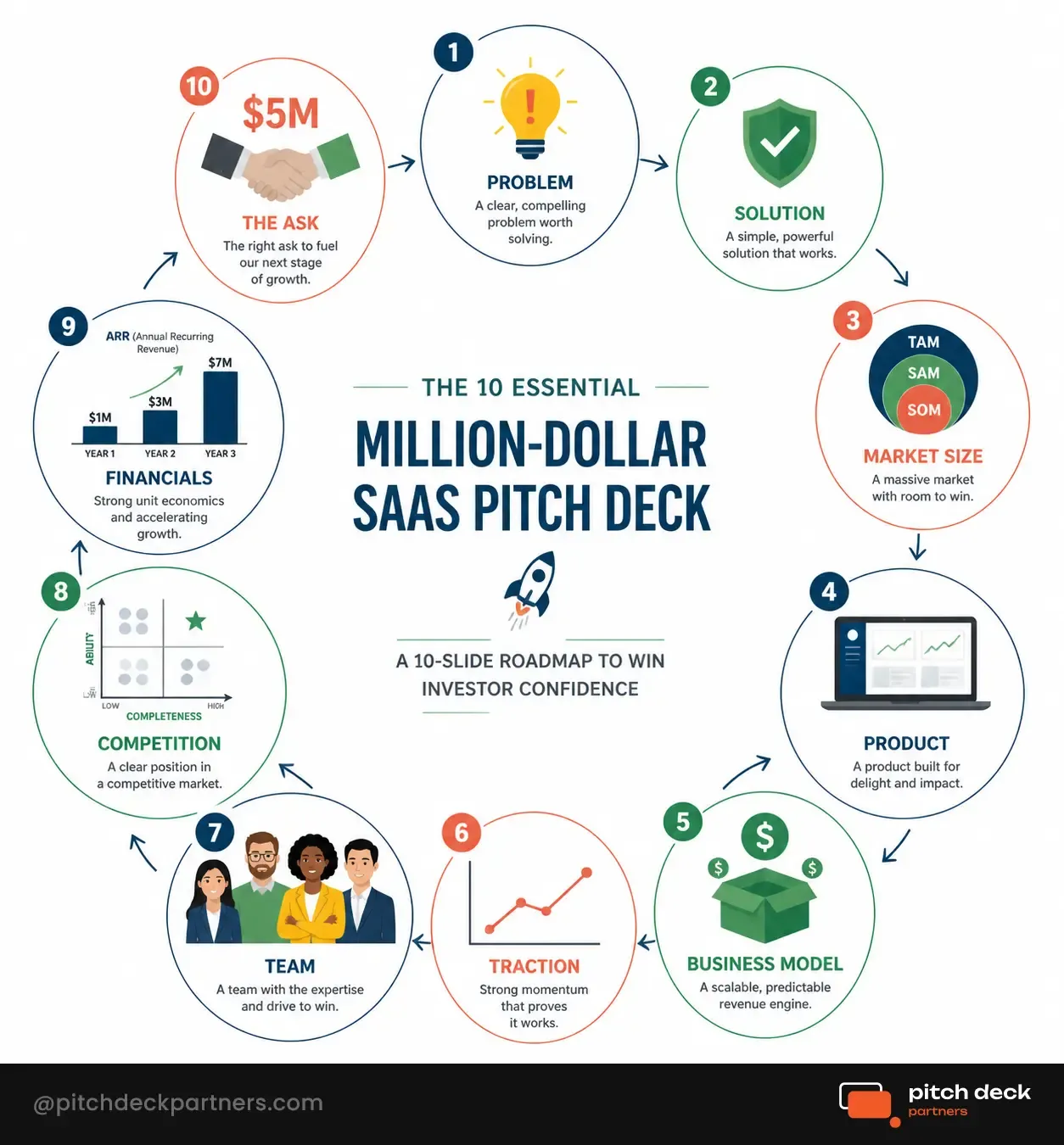
Slide 1: Problem
State the problem in one sentence. Show that it is painful, frequent, and currently unsolved at scale. Investors reject decks where the problem slide reads like a market trend report - make it feel real, not academic.
Slide 2: Solution
Show the product as the direct answer to the problem you just defined. Avoid feature lists. Investors want to understand the mechanism - how your solution removes the pain, not what buttons it has.
Slide 3: Market size
Break your TAM, SAM, and SOM clearly. Use a bottom-up calculation, not a top-down percentage of a massive industry number. A TAM claim of "$500B addressable market" with no supporting logic is the fastest way to lose credibility in the room.
Slide 4: Product
Show the product - screenshots, a short demo, or a workflow diagram. Do not describe it in bullet points. Investors need to see what you have built, not imagine it from a list of capabilities.
Slide 5: Business model
Explain how you charge, how often, and why. For SaaS, this means subscription tier structure, average contract value, and whether you're PLG, sales-led, or hybrid. Vague "freemium + enterprise" language without specifics is a red flag.
Slide 6: Traction
Show growth - monthly, not annualised. MRR trajectory, customer count growth, retention rate, and any key enterprise logos, if applicable. Investors expect to see the curve, not just the current number.
Slide 7: Team
Explain why this team builds this product better than anyone else. Highlight domain expertise, prior exits if relevant, and specific execution evidence. Generic team bios with LinkedIn-style credentials do not build conviction.
Slide 8: Competition
Show a competitive landscape that is honest, not self-serving. A "we have no real competitors" positioning reads as naivety. Map your positioning clearly against 3-4 real alternatives and name your differentiated advantage.
Slide 9: Financials
Show a 3-year projection with key SaaS assumptions visible: ARR growth rate, gross margin, burn rate, and path to profitability (or rule-of-40 framing). Investors are not expecting perfect accuracy - they are evaluating whether your financial thinking is coherent.
Slide 10: The Ask
State exactly how much you are raising, at what stage, and how the capital will be deployed across the next 18 to 24 months. Founders who say "we're raising between $2M and $5M" signal they have not made a decision, which is itself a decision investors notice.
The SaaS metrics investors expect to see (and where to put them)
Generic pitch deck advice tells you to include financials. A pitch deck design for a SaaS company fundraising requires specific metric literacy - because SaaS investors are pattern-matching against benchmarks they see every week.
Here are the six metrics that matter most, which slide they belong in, and what "fundable" looks like versus a red flag:
MRR (Monthly Recurring Revenue)
- Traction slide. Fundable: consistent month-over-month growth above 10-15% at an early stage. Red flag: flat MRR for 3+ months with no explanation.ARR (Annual Recurring Revenue)
- Financials slide. Fundable: clear ARR trajectory that supports your raise size. Red flag: ARR that doesn't reconcile with your MRR figure.Churn Rate
- Traction or Financials slide. Fundable: net revenue churn below 2% monthly for SMB, below 1% for mid-market. Red flag: high gross churn masked by expansion revenue without disclosure.LTV (Customer Lifetime Value)
- Business Model slide. Fundable: LTV:CAC ratio above 3:1 with a payback period under 18 months. Red flag: LTV calculated without factoring in churn.CAC (Customer Acquisition Cost)
- Business Model or Traction slide. Fundable: CAC that is clearly understood by the channel. Red flag: blended CAC that mixes organic and paid without distinction.NRR (Net Revenue Retention)
- Traction slide. This is the metric most founders underemphasise. An NRR above 110% means your existing customers are growing your revenue without new acquisition - one of the strongest signals in SaaS investing. A good pitch deck design consultant will build these metrics into the slide structure from the start, not bolt them on at the end.Common SaaS pitch deck mistakes that kill funding conversations
Investors see hundreds of decks each quarter. The ones that fail tend to fail in the same ways. Here is what a seasoned pitch deck design consultant sees most often - written from the investor's perspective.
Vague TAM claims:
"The global SaaS market is worth $700 billion" is not a market sizing argument. It is a Google search result. When an investor sees this, they immediately question whether the founder understands their actual customer base.
No clear ARR trajectory:
Showing a current ARR number without a growth context is meaningless. Investors want to see the arc - where you were 6 months ago, where you are now, and the assumptions behind where you are going.
Cluttered slides:
When a single slide contains a paragraph, three bullet points, two charts, and a product screenshot, investors stop reading and start skimming. White space is not wasted space - it is a design decision that signals confidence.
Missing the competition slide:
Founders who skip the competition slide because they believe they have "no real competition" are signalling one of two things: the market does not exist, or they have not done their research. Neither is fundable.
Weak team narrative:
A list of universities and job titles is not a team story. Investors fund people, and a compelling team slide answers: why are these specific people uniquely positioned to win this specific market?
Burying the ask:
If an investor has to search for what you are raising and how you will use it, the deck has already lost the conversation.
What does a million-dollar SaaS pitch deck actually look like?
The best-designed pitch decks in history share a structural trait: they are aggressively simple. Not sparse, but focused. Every slide does one job, and together they build an argument that holds.
Airbnb (2009 seed deck): One of the most referenced decks in startup history. Eleven slides. The problem slide was three bullet points. The market slide showed a simple number with sourcing. No unnecessary visuals, no padded content. The simplicity was the message - the team knew exactly what they were building and exactly who it was for.
Intercom (Series A): Intercom's deck was notable for how clearly it defined the product category before showing the product. They did not ask investors to understand a new kind of software - they framed it as the obvious next evolution of customer communication. Story-first, product second.
Zuora (enterprise SaaS): Zuora built its pitch around a macro narrative - the "subscription economy" - and then positioned its product as the only logical infrastructure play. By naming the category before naming the company, they gave investors a mental framework to evaluate the bet.
What connects all three is the work of a strong pitch deck design agency embedded in the narrative from slide one - not applied as a visual afterthought at the end.
SaaS pitch deck design: why visuals are a trust signal, not decoration
Most founders think of design as the last step - the part where you make things look nice before you send the deck. Investors think of it differently.
When a slide is cluttered, the implicit message is that the team cannot prioritise. When fonts are inconsistent, the implicit message is that attention to detail is not a company value. When data visualisations are hard to read, investors question whether the founder understands their own numbers.
The best pitch deck design for SaaS companies treats every visual decision as a communication decision. Color is used to guide attention, not to express personality. Typography creates hierarchy, not style. Charts are stripped to their essential message - no gridlines, no unnecessary labels, no decorative elements that compete with the data.
Working with a pitch deck design agency that understands SaaS investor expectations means the design itself becomes part of the argument. A well-designed deck signals that the team ships with care, presents with clarity, and respects the reader's time.
How to build your SaaS pitch deck: a step-by-step action plan
Build your SaaS pitch deck in five steps: define your funding ask first, map your narrative arc before building any slides, construct each slide in sequence, stress-test the deck with someone who does not know your business, and apply design for clarity last. Start with the story, not the slides.
Step 1 - Define your funding ask: Before you write a single slide, decide: how much are you raising, at what valuation range, and for what milestone? Every other decision in the deck flows from this anchor.
Step 2 - Map your narrative arc: Write a one-paragraph story of your company - problem, insight, solution, market, traction, team, ask. If you cannot write it in a paragraph, you cannot build it in 12 slides. The Sequoia framework is a reliable starting point.
Step 3 - Build slide-by-slide: Follow the 10-slide sequence. Write content first in a Google Doc before touching any presentation software. Slides built inside design tools tend to be over-designed and under-argued.
Step 4 - Stress-test with a cold reader: Share the deck with someone who does not know your business - a friend, a peer founder, or a pitch deck design consultant. Ask them: What is the business? Who is the customer? Why does it matter? If they cannot answer all three, the deck is not ready.
Step 5 - Design for clarity: Apply design as a final layer, not a first layer. Hierarchy, whitespace, and consistent visual language are the three non-negotiables. Everything else is preference.
Conclusion
A great product and a fundable pitch deck are not the same thing. Investors meet hundreds of founders. What separates the ones who close rounds from the ones who don't is rarely the quality of the software - it is the quality of the story and how clearly it is structured and presented.
Three things every investor-ready SaaS deck must do: make the problem undeniable, make the traction believable, and make the ask obvious. Every slide either supports one of those three goals or it does not belong in the deck.
The best pitch deck design agency for SaaS companies is not about aesthetics. It is a strategic document built to generate conviction in a 20-minute meeting. If your deck is not doing that job, it is time to rebuild it from the story out - not from the slides in.
FAQs
1. How long should a pitch deck be?
A pitch deck should be 10 to 13 slides for the main presentation. Anything beyond 13 slides dilutes focus. Keep supporting material - detailed financials, technical specs, customer case studies - in a separate appendix shared after the investor meeting.
2. What font should I use in a pitch deck?
Use a clean, modern sans-serif font. Inter, DM Sans, and Helvetica Neue are reliable choices for SaaS decks because they read well at small sizes and carry a professional weight without being generic. Avoid decorative or serif fonts on data-heavy slides.
3. Do investors read every slide?
Most investors form an initial impression within the first three slides. If the problem and solution slides do not create immediate interest, many investors will skim the rest rather than read it carefully. Structure your deck so the first three slides can stand alone as a compelling argument.
4. What is the difference between a pitch deck and a business plan?
A pitch deck is a visual fundraising instrument designed for a 15-to-20-minute investor meeting. A business plan is a comprehensive written document covering operations, financials, and strategy in depth. Investors at the seed and Series A stage rarely request a business plan - the deck and a financial model are the standard expectation.
5. What makes a SaaS pitch deck different from a regular startup deck?
A pitch deck designed for a SaaS company should showcase subscription economics, including metrics like monthly recurring revenue growth, net revenue retention, churn rate, and the LTV to CAC ratio. Unlike generic startup decks that emphasize overall revenue and user growth, SaaS investors look for specific indicators tied to the subscription model. A deck that doesn't include these key metrics may suggest that the company isn't prepared for investor scrutiny.