



Quick Read
A fintech pitch deck has to prove three things. You understand regulation, your unit economics work, and customers will find you. Investors in this space come from banking, payments, and credit, so they check your numbers fast.
The guide covers:
- What a fintech deck is and how long it should be
- What investors expect from founders
- The essential slides, in a sensible order
- The metrics to show, including sub-sector metrics
- How to present compliance without losing the room
- Common mistakes, design principles, and a final checklist
Introduction
Money is personal. When a startup asks people to trust it with their cash, investors ask harder questions than they do in most other sectors. They want to know who regulates you, how you earn on each transaction, and how you will grow without taking reckless risks.
That is why a fintech pitch deck works differently from a standard startup deck. Regulation, trust, and complex revenue mechanics all need space on your slides; a generic template skips most of that.
Many founders search for a pitch deck fintech template, fill in the blanks, and send it out. Investors spot the shortcut quickly. Most decide within minutes whether a deck deserves a second look. Fintech specialists first scan for licenses, take rate, and team background.
The guide walks you through what the deck is, what investors expect, which slides and metrics matter, and where founders lose credibility. You will also get a checklist to run before you hit send.
What Is a Fintech Pitch Deck?
A fintech startup pitch deck is a short, structured document that explains your problem, product, market, business model, and traction. In financial services, it also needs to show you understand the industry's rules.
Think of it as a summary, not a business plan. It gives a reader enough context to understand your company without a call.
Purpose, ideal length, and file format
The deck does three jobs. It orients readers quickly, organizes information in a predictable order, and serves as a reference when investors share it with partners or compare you with other deals.
Most fintech decks run 10 to 14 slides. Early-stage companies can stay near 10 to 12. Complex models, such as multi-sided markets or heavy licensing needs, may need up to 14. Longer decks tend to repeat themselves.
That range supports an ideal pitch deck structure: problem first, then solution, market, business model, traction, risk, financials, and team. Keep the order steady so readers never lose the thread.
Send the deck as a PDF. The layout stays fixed on every device, and investors can forward it without you narrating. Use a 16:9 ratio and keep each slide easy to scan.
Core deck vs. extended deck and appendix
Most teams keep two versions. The core deck holds the main 10 to 14 slides and should stand on its own. The extended version holds the deeper material.
Good appendix content includes detailed financial assumptions, regulatory notes, technical architecture, and market research tables. Label it clearly as separate from the story.
The appendix supports follow-up questions. It should never rescue weak core slides.
What Investors Expect from a Fintech Founder
Before you design a single slide, know what the reader is looking for. Fintech investors score founders on a few clear points.
Regulatory clarity, domain expertise, and responsible scale
Fintech investors treat regulation as part of product-market fit. You need to explain which licenses you need, which you hold, and how long the rest will take. Founders who say they will sort out compliance later signal that they have not priced the real cost.
Domain expertise matters just as much. Investors back founders who have worked in banking, payments, lending, or compliance. “Passionate about fintech” is not a credential. Six years building credit models is.
Responsible scale is the third expectation. The lending and buy-now-pay-later boom left many investors cautious. They want disciplined operators with sound credit policies, fraud controls, and a compliance setup that grows with volume.
Distribution strategy and capital efficiency
Building a financial product is hard. Getting people to use it is often harder. Consumer acquisition costs can run high, and business sales cycles can run long. Embedded finance helps because distribution comes built in through partners.
Show how you will reach customers cheaply and keep them. Name your channels, partners, and costs. Then pair that with a plan for capital-efficient growth, so investors see each dollar moving a clear milestone.
Any VC pitch deck guide will tell you to prove team, market, and traction. Fintech adds two more tests: regulatory readiness and unit economics that hold up under pressure.
Essential Slides for a Fintech Pitch Deck
A strong deck uses a set of pitch deck components that every investor expects, plus a few that only fintech needs. The list below follows a sensible order. Adjust it to fit your story, but keep the logic.
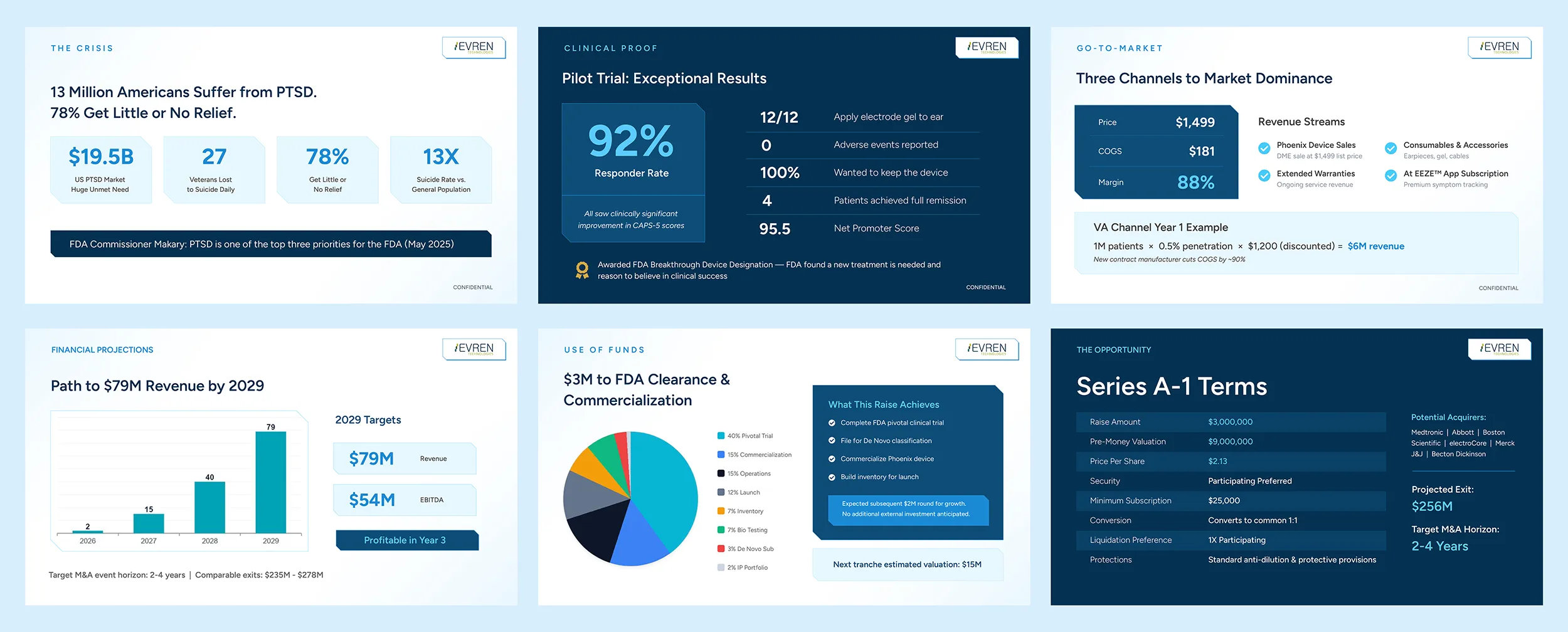
1. Title and one-line descriptor
Give your company name, logo, and one clear line about what you do. “Embedded lending for B2B software platforms” works. A paragraph about making finance fair for everyone does not. Add contact details, and consider a short funding note in the footer.
2. Problem
Name a specific customer and put a number on their pain. Fintech problems usually fall into two types. Either people pay too much or wait too long for a service they already use, or a group cannot reach the service at all.
“Small exporters lose a slice of every cross-border payment to fees and delays” beats “Businesses struggle with old infrastructure.”
3. Why now and market shift
Explain what changed so your product works today. Regulatory shifts like open banking rules, new infrastructure providers, and changing customer habits all count.
Skip vague talk about digital transformation. Investors want a structural reason tied to rules or infrastructure.
4. Solution and product demo
Show the product. Use one screenshot, one flow, or a before-and-after view. Skip the feature list.
Make the improvement obvious, whether it is speed, cost, transparency, or compliance.
5. How it works (system design and integrations)
Use one clean diagram. Show your connections to banks, KYC and AML providers, payment processors, or credit bureaus. Mark what you own and what depends on partners.
Use plain words instead of internal system names. Investors should grasp the flow of money and data in seconds.
6. Market opportunity (TAM, SAM, SOM)
Size the market from the bottom up. Multiply target customers by average volume by your take rate. Giant global totals tell investors nothing about what you can reach.
If you need licenses state by state, your near-term market is smaller than the full national total. Say so. Investors respect the honesty.
7. Business model and revenue mechanics
Explain who pays, when they pay, and what triggers the fee. Walk through one unit example: user action, transaction, fee, cost, margin.
Focus on one or two main revenue streams. Interchange, spread, subscription, and float all work differently, so name yours.
8. Traction and signals
Usage is proof of trust in financial services. Show transaction volume, funds moved, active accounts, repeat usage, pilots, letters of intent, and licensing milestones.
Put a time frame on every number. Define terms like “active,” so nobody has to guess.
9. Go-to-market and distribution
Show how you reach customers and what it costs. Consumer products need cost per channel and payback time.
Business products need sales cycle length and deal size. Embedded models need named partners and a clear revenue share.
10. Regulatory and risk slide
Cover your licenses, your compliance approach, and your top risks with the fix for each. Keep the tone factual. Section seven covers a simple format for it.
11. Competitive landscape and moat
Skip the “no competition” claim. Use a matrix or two-by-two chart, then name your edge. It might be proprietary data, a risk model, a distribution channel, or a regulatory position that rivals will not copy.
12. Team
Fintech runs on execution and trust. Highlight experience across regulation, technology, and go-to-market. Add advisors with licensing or capital markets backgrounds, and tie each person to a function.
13. Vision and funding ask
Close with where the company goes next, then make the ask. State the amount, the use of funds, and the milestones you will hit before the next round.
A concrete ask sounds like this: “We are raising to secure licenses in more states and reach a set volume target.” Vague asks get vague answers.
Fintech Metrics Investors Want to See
Numbers carry a financial pitch deck. Fintech investors check a core set first, then the sector-specific ones. Present each metric with a clear definition and a time frame.
1. CAC and CAC payback
CAC refers to the amount you invest to acquire a single customer. Show it fully loaded and split by channel. Payback shows how many months it takes to earn that money back.
Many investors want payback in roughly 12 to 18 months. Top fintechs aim for the shorter end.
2. LTV: CAC ratio
Divide lifetime value by CAC to see whether growth pays off. A ratio of 3:1 or better is a common benchmark.
Break out revenue per customer over time so the ratio feels earned, not guessed.
3. Net revenue retention
Net revenue retention tracks revenue from existing customers after upsells and churn. Strong business-focused fintechs often aim for 120 percent or higher.
A number above 100 percent tells investors your customers grow with you.
4. Take rate and net interest margin
Take rate is the share you keep from each transaction. Payment processors often sit between 0.5 and 3 percent. Lenders watch net interest margin, which commonly lands between 3 and 8 percent.
Show whether the figure holds as volume grows. Shrinking margins at scale worry investors.
5. Default and loss rates (for lending)
Lenders must show default and loss rates, both expected and actual, with the underwriting logic behind them. Consumer lenders often aim for defaults below 5 percent with quality underwriting.
A target number with no model behind it earns little trust.
6. Transaction volume and funds moved
Show gross transaction volume, loan originations, or funds moved, with the trend line. Then show the revenue you earn from that volume.
Never present volume as revenue. It is the fastest way to lose a fintech investor’s confidence.
Metrics by Fintech Sub-Sector
A payments deck and a lending deck are different documents. Pick the metric set that matches your model and drop the rest.
-
- Payments: gross transaction volume, take rate, margin after processing costs, and merchant payback. Investors watch for margins that shrink as large customers negotiate.
- Lending: origination volume, loss rate, net interest margin, and repeat borrower rate. Show credit quality, not only growth.
- Neobanks: monthly active accounts, revenue per active account, and cost to serve. Name your partner bank or license structure.
- Wealthtech: assets under management, net new assets, fee rate, and client retention.
- Insurtech: gross written premium, loss ratio, and combined ratio. A loss ratio above 80 percent needs a believable path down. State clearly whether you operate as an agent or a carrier.
- Embedded finance: signed distribution partners, contract value, and time to activation. Show a pipeline of partners, not one logo.
Ready to Take Your Pitch Deck to the Next Level?
If you found this guide helpful, imagine what we can do for your actual deck.
How to Present Regulation and Compliance Without Losing the Room
Compliance can sink a deck in two ways. Some founders skip it. Others bury readers in legal detail. Aim for calm, clear awareness.
Regulation can also work in your favor. Licenses and compliance systems take time and money to build, so they can become a moat that slower rivals struggle to copy.
Licenses held, in progress, and planned
Say which licenses you hold, which applications are pending, and which you plan to file. State the status plainly. Never claim an approval you do not have. Add your AML and KYC approach. Do you run your own stack, use a vendor, or rely on a banking partner? If you operate under another firm’s charter, name that firm. Even at pre-seed, one slide is enough. Skipping it is the quickest way to look inexperienced.The “Exposure, Control, Status” format
Use three columns. Exposure names the risk, such as licensing delays or fraud. Control names what you do about it, such as a compliance hire or a partner. Status shows where things stand today.
Keep it to four to six bullets in total. Investors read it in seconds and see a team that manages risk instead of hiding from it.
Slides That Get Extra Scrutiny
Investors read fintech pitch decks with a sharper eye than generalist decks. Three slides get the most time, so prepare for deep questions on each.
-
- Team: Investors look for a finance or fintech background, compliance experience, security depth, and a record in regulated industries. If you lack one of these, name the advisor or hire who fills the gap.
- Business model: Revenue mechanics must be crystal clear. Explain how you make money, what affects gross margin, and what could hurt revenue, such as fraud or failed payments. Show partner dependencies too.
- Traction: Expect questions on active versus registered accounts, volume trends, and licensing progress. Pilots, letters of intent, and signed partners all count as proof.
Common Fintech Pitch Deck Mistakes
Most red flags in pitch decks can be fixed before your next meeting. Fintech investors rarely explain a pass. They just move on to the next deck.
-
- Skipping regulation: Founders who assume investors will not care, or who plan to deal with it later, look naive. Compliance becomes the first question in every meeting.
- A vague wedge: Better design alone does not win. Name what makes you hard to beat, whether it is a proprietary underwriting model, unique data access, or an underserved channel.
- Weak unit economics: Many fintech decks read like consumer software decks. Investors want loss ratios, take rate trends, and cohort data because real money is at stake.
- Inflated TAM: A trillion-dollar market claim helps nobody. Show the segment you can actually reach and how you will win it first.
- No trust narrative: Users hand you their money. Explain how you earn their confidence, especially in underbanked markets, through security, partners, licenses, and transparent pricing.
One more habit causes quiet damage: changing metric definitions from slide to slide. If “customers” means accounts on one slide and paying businesses on another, readers stop trusting the rest.
Design Principles for Fintech Decks
Design signals care. In financial services, careless slides suggest careless money handling. A few simple principles keep your deck credible.
-
- Clarity: Give each slide one job. Use a headline, three to five bullets, and one visual. Move extra detail to the appendix.
- Data visuals: Use clean charts with labeled axes and time frames. Show the trend, not only the total. Replace big adjectives like “revolutionary” with specifics about what the product does and for whom.
- Text density: Slides are not documents. Walls of text and tiny tables make a deck unreadable on the
- First pass: If a slide needs narration to make sense, it is doing too much.
- Trust signals: Add partner logos, license names, security certifications, and notable advisors. Keep fonts, colors, and spacing consistent so the whole deck feels steady and precise.
The best fintech pitch decks look calm and exact. Strong investor pitch deck design puts clarity first and decoration second.
If design is not your strength, a fintech pitch deck design agency can turn dense data into slides that read in seconds. Look for a team that already understands licensing, risk, and financial metrics, so you do not spend weeks explaining them.
Pitch Deck Checklist Before You Send It to Investors
Run through the list below before the deck leaves your hands.
-
- Does the first slide explain what you do in one short line?
- Does a regulatory slide show licenses held, in progress, and planned?
- Do the business model, traction, and financial slides use the same metric definitions?
- Is volume clearly separated from revenue?
- Does every traction number carry a time frame?
- Do CAC, payback, and LTV: CAC use fully loaded costs?
- Is the market sized from the bottom up?
- Does the team slide show fintech-specific credentials?
- Does the ask name an amount, a use of funds, and a milestone?
- Is the core deck 10 to 14 slides, with extras moved to the appendix?
Next, rehearse your fintech startup pitch deck presentation out loud. You will catch unclear slides faster when you have to explain them.
Finally, get a second opinion. Pitch Deck Consulting gives you an expert review before investors see the deck, which is far cheaper than a pass you never hear the reason for.
Final Thoughts
A fintech deck answers one question. Does this founder understand the business well enough to handle other people’s money responsibly?
Show that with clear regulation, honest metrics, and a distribution plan that holds up. Keep the slides clean and the definitions consistent. Do those things well, and your deck becomes proof of good judgment.
Pitch Deck Partners helps founders turn complex financial products into clear, investor-ready stories. Our fintech pitch deck design services cover story, structure, and slides, so your numbers and your compliance plan land the way you intend.
Ready to get your deck funding-ready? Contact Pitch Deck Partners and let’s talk about your raise.
Frequently Asked Questions
1. How many slides should a fintech pitch deck have?
Aim for 10 to 14 slides in the core deck. Put financial models, regulatory notes, and technical diagrams in a separate appendix.
2. Do I need a regulatory slide at pre-seed?
Yes. One slide covering licenses held, applications pending, and your AML and KYC approach is enough early on. Skipping it signals inexperience.
3. What metrics do fintech investors look at first?
They start with CAC, payback, LTV: CAC, and burn. Then they check sector metrics such as take rate, loss rate, net interest margin, or revenue per active account.
4. How is a fintech deck different from a standard startup deck?
It adds a regulatory slide and goes deeper on business model, unit economics, and traction. Volume, margin, and active accounts matter more than raw user counts.
5. What do later-stage investors want that early investors do not?
They want proof from real data, such as actual loss rates, take rates, and acquisition costs. They also expect a funded path through licensing and a sales motion you can repeat.